
Delayed Lockstep
Overview
Delayed lockstep is a fault‑detection technique in which two processing channels execute the same instruction stream with a small, intentional time offset. This temporal diversity reduces the probability that a disturbance affects both channels during the same logical operation, improving robustness against common‑cause faults.
Motivation
In cycle‑by‑cycle lockstep, both cores execute the same instruction in the same clock cycle. A simultaneous disturbance—such as an EMI burst, voltage dip, or radiation strike—may corrupt both cores identically, producing matching wrong outputs that the comparator cannot detect.
By introducing a delay of one or more cycles between the main core and the checker core, the same disturbance affects different instructions, making mismatches detectable.
Architecture Concept
A delayed lockstep system consists of:
- Main core — executes the instruction stream normally.
- Checker core — executes the same instructions but with a fixed delay.
- Comparator — aligns the outputs of the two cores in time and checks for mismatches.
- Buffering logic — stores the main core’s outputs until the checker core reaches the corresponding instruction.
Figure 1: Delayed Lockstep Timing Diagram
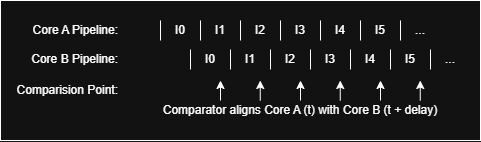
Delayed lockstep timing. The checker core executes the same instruction stream with a fixed cycle offset. A disturbance occurring at a single physical instant affects different logical operations in the two cores, making mismatches detectable and improving robustness against common‑cause faults.
Benefits
- Improved common‑cause fault detection — temporal diversity prevents identical corruption.
- Low hardware overhead — similar to standard lockstep, with added buffering.
- Compatible with existing CPU architectures — requires minimal changes to the execution pipeline.
Limitations
- Detection latency — faults are detected after the delay interval.
- Not effective against long‑duration disturbances — if a disturbance persists across multiple cycles, both cores may still be affected.
- Requires precise alignment logic — comparator and buffering must be tightly synchronized.
Use Cases
- Automotive microcontrollers
- Industrial safety controllers
- Avionics processors
- Radiation‑tolerant embedded systems
