
Security in Protocol Layers
Overview
Protocol layers define how two entities identify each other, exchange messages, maintain session state, and verify the integrity and freshness of communication. From a security perspective, a protocol is not just a transport mechanism — it is a decision system that determines:
- who is allowed to communicate
- what operations are permitted
- how tampering is detected
- how state consistency is maintained
- how replayed or malformed traffic is rejected
Security analysis at the protocol level focuses on:
- authentication
- message integrity
- freshness and replay protection
- robustness of state machines
- session management
- resistance to DoS and metadata manipulation
Protocol Layer Threat Surface
Figure 1 — Protocol Layer Threat Surface
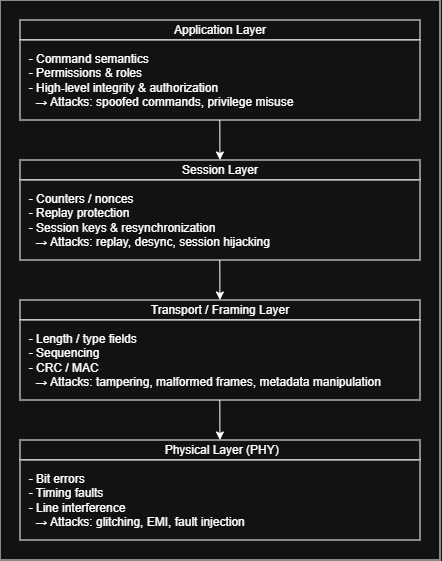
A layered view showing where different classes of attacks apply across physical, framing, transport, session, and application layers.
Main Security Threats
Identity & Authentication Attacks
- Endpoint spoofing
- Impersonation of legitimate nodes
Integrity & Tampering
- Modification of payload, headers, or metadata
- Manipulation of length, type, priority, or routing fields
Freshness & Replay
- Re‑sending previously valid frames
- Reusing sequence numbers or nonces
State Machine Abuse
- Out‑of‑order messages
- Illegal transitions
- Malformed or incomplete frames
Desynchronization
- Diverging counters
- Broken session state
- Manipulated timers or timeouts
Denial of Service
- Flooding with valid or malformed frames
- Exhausting buffers or CPU time
Mitigation Techniques
Authentication
- Challenge‑response
- Symmetric keys or certificates
Integrity Protection
- MAC/HMAC
- Digital signatures
- Keyed CRC
Freshness & Replay Protection
- Sequence counters
- Nonces
- Sliding acceptance windows
Figure 2 — Replay & Freshness Mechanism

How sequence counters and acceptance windows prevent replayed or stale messages.
Robust State Machines
- Explicit transitions
- Strict timeout rules
- Illegal‑state detection
Figure 3 — Protocol FSM Abuse

Detection and recovery from malformed or out‑of‑order messages that attempt to push the protocol FSM into invalid states.
Message Integrity Pipeline
- Header + payload integrity
- MAC/signature verification
- Reject/accept logic
Figure 4 — Message Integrity Pipeline
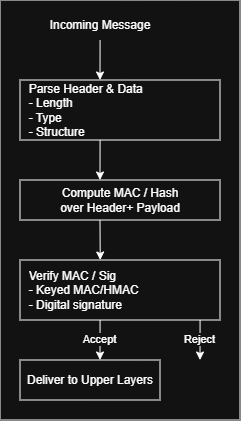
The processing pipeline that validates message structure, integrity, and authenticity before acceptance.
Session Management & Resynchronization
- Counter alignment
- Session key updates
- Controlled resync procedures
Figure 5 — Session Desynchronization Flow
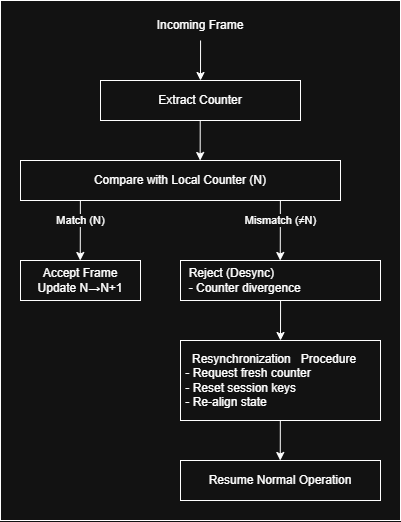
How a protocol detects counter divergence and performs controlled resynchronization.
Deep‑Dive Pages
These dedicated sub‑pages provide detailed explanations of the core security mechanisms introduced in this section:
- Replay Protection & Freshness
- Protocol State Machine Security
- Message Integrity & Authentication Pipeline
- Session Management & Resynchronization
Relationship with Safety
Security and Safety share several mechanisms — CRC, counters, timeouts, and state machine monitoring — but their intent differs:
- Safety detects random communication faults.
- Security detects malicious manipulation and protocol abuse.
Fault injection attacks can mimic communication errors, so robust protocol design must address both domains.
