
Safety in CRC
Overview
Cyclic Redundancy Check (CRC) is one of the most widely used mechanisms for detecting data corruption in digital systems. In safety‑critical designs, CRC plays a central role in ensuring that data transmitted across interfaces, stored in memory, or processed by functional blocks has not been altered by faults. Safety analysis focuses on the robustness of the CRC polynomial, the integrity of the generator/checker logic, and the diagnostic coverage provided by CRC‑based mechanisms.
Main Safety Risks
- Silent data corruption — faults in transmission, storage, or processing may alter data without immediate detection.
- CRC logic corruption — faults in the generator or checker may invalidate the protection mechanism.
- Polynomial mismatch — inconsistent CRC configurations between transmitter and receiver.
- Bit‑flip faults — SEU or SET events affecting data or CRC fields.
- Truncated CRC fields — insufficient CRC length reducing diagnostic coverage.
- I/O‑related upstream faults — digital I/O failures (stuck‑high, stuck‑low, open) affecting protected data.
- Clock or timing faults — misalignment between data and CRC fields in streaming interfaces.
Figure 1 — CRC Failure Modes
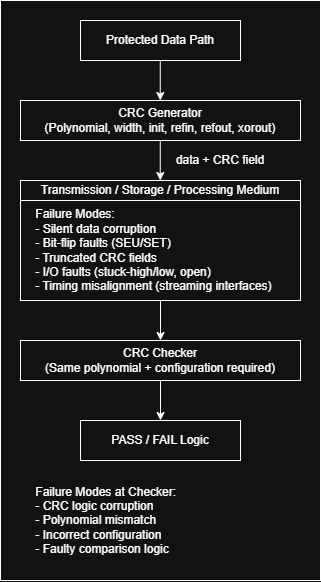
Conceptual view of the main failure modes affecting CRC‑protected data paths, including corruption in transmission/storage, CRC logic faults, polynomial mismatches, and bit‑flip events.
Mitigation Techniques
- Robust polynomial selection — using polynomials with high Hamming distance for the target data length.
- Redundant CRC computation — dual CRC engines with comparison for high‑integrity systems.
- End‑to‑end protection — CRC applied across multiple system boundaries (sensor → MCU → interface).
- CRC over metadata — protecting headers, counters, and control fields.
- Cross‑checking — verifying CRC fields at multiple points in the data path.
- Diagnostic counters — tracking CRC failures and unexpected patterns.
- Built‑In Self‑Test — validating CRC generator/checker logic at startup.
- ATPG/DFT support — scan‑based observability of CRC logic and fault coverage measurement.
Figure 2 — Hardened CRC Structures
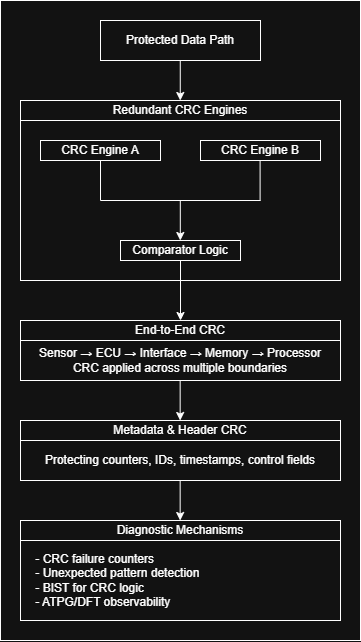
Conceptual view of hardened CRC architectures, including redundant CRC engines, end‑to‑end protection, metadata protection, cross‑checking, and diagnostic mechanisms.
Related Technical Pages
- CRC — Overview, Families & Architecture
Foundational description of CRC purpose, polynomial families, and architectural variants. - CRC — Mathematical Background
Formal properties of CRC polynomials, Hamming distance, burst‑error detection, and algebraic structure. - CRC — RTL Architecture & Implementation Notes
Hardware implementation patterns, generator/checker structures, pipelining, and synthesis considerations. - CRC — Verification & Test Vectors
Reference test vectors, verification strategies, and cross‑checking techniques. - CRC — Reference Table
Common CRC polynomials, widths, refinements, and parameter sets used across industry standards.
