
Security in Power Management
Overview
Power management governs how voltage domains are enabled, monitored, and sequenced. Because every subsystem depends on stable, predictable, and authenticated power conditions, attackers can exploit the power network to:
- induce faults
- bypass security checks
- corrupt initialization
- force undefined states
- disable or desynchronize subsystems
Security analysis focuses on protecting power rails, monitoring circuits, sequencing logic, and domain isolation from intentional manipulation.
Conceptual Diagram — Where Power Attacks Occur
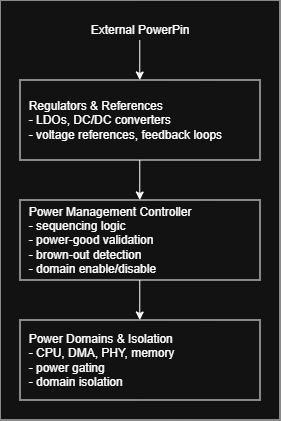
Attacks can target any layer: regulators, monitoring circuits, sequencing logic, or domain isolation.
Main Security Threats
Voltage Manipulation Attacks
Forcing:
- undervoltage
- overvoltage
- rapid fluctuations
to corrupt logic or bypass checks.
Brown‑Out Exploitation
Dipping supply rails below safe thresholds to trigger:
- partial resets
- undefined states
- reset loops
Power‑Good Spoofing
Forging or manipulating power‑good signals to mislead:
- initialization logic
- reset controllers
- sequencing engines
Sequencing Abuse
Altering the order or timing of power‑up/down to:
- desynchronize subsystems
- bypass initialization
- force illegal states
Domain Isolation Bypass
Injecting signals into powered‑down domains or exploiting leakage paths.
Power Switch Tampering
Forcing power‑gated blocks on or off to:
- expose internal states
- disrupt operation
- bypass isolation
Thermal Manipulation
Overheating regulators or references to:
- degrade stability
- force shutdown
- alter voltage thresholds
Analog Front‑End Probing
Accessing:
- sense lines
- references
- feedback loops
to alter regulator behavior.
Denial of Service
Repeatedly forcing power faults to prevent normal operation.
Mitigation Techniques
Voltage Supervision and Anomaly Detection
Monitor:
- dips
- spikes
- instability
- abnormal patterns
across all rails.
Brown‑Out Protection
Enforce controlled reset and recovery sequences when thresholds are violated.
Secure Power‑Good Validation
Cross‑check power‑good signals with:
- real voltage measurements
- redundant comparators
- timing constraints
Sequencing Controllers
Enforce strict:
- power‑up order
- power‑down order
- timing constraints
to prevent desynchronization.
Domain Isolation Hardening
Ensure powered‑down domains:
- cannot leak signals
- cannot propagate transitions
- remain electrically isolated
Redundant Regulators and References
Use dual‑path or monitored supplies for high‑integrity systems.
Thermal Monitoring
Detect:
- overheating
- abnormal thermal gradients
- regulator stress
Configuration Locking
Protect power controller registers and thresholds after initialization.
Glitch and Fault Injection Resistance
Apply:
- filtering
- debouncing
- timing supervision
to power‑related signals.
Built‑In Self‑Test
Validate:
- power management logic
- analog components
- sequencing behavior
to detect tampering or degradation.
Relationship with Safety
Safety addresses random power faults:
- noise
- drift
- regulator degradation
- thermal stress
Security addresses intentional manipulation:
- crafted undervoltage
- forced brown‑outs
- spoofed power‑good
- malicious sequencing
Overlap
- Fault injection mimics brown‑out or voltage instability
- Power‑good validation strengthens both domains
- Domain isolation protects against leakage and malicious injection
