
Secure Communication and Key Management
Overview
Secure communication ensures that data exchanged between endpoints is authentic, untampered, and confidential when required. Key management governs how cryptographic keys are generated, derived, rotated, stored, and retired during communication sessions.
While Secure Boot and Key Management establishes the platform root of trust, this page focuses on runtime communication security:
- session keys
- key derivation
- key rotation
- secure channel establishment
- binding keys to counters/nonces
- preventing replay and impersonation
- protecting keys during operation
These mechanisms form the backbone of secure protocols, ensuring that even if an attacker can observe or inject traffic, they cannot forge messages or impersonate endpoints.
Threat Model
1. Key Extraction During Communication
Attackers attempt to retrieve session keys via:
- side‑channel analysis
- memory probing
- DMA attacks
- debug interface abuse
2. Key Replay or Reuse
Reusing the same key across sessions or devices enables:
- replay attacks
- cross‑device impersonation
- predictable MAC forgery
3. Weak Key Derivation
Poor KDFs allow attackers to:
- guess derived keys
- exploit low entropy
- correlate keys across sessions
4. Man‑in‑the‑Middle (MitM)
Intercepting or modifying messages during key exchange.
5. Downgrade Attacks
Forcing endpoints to use weaker algorithms or older keys.
6. Desynchronization of Key Material
Endpoints disagree on:
- session keys
- counters
- nonces
- key epochs
Leading to denial of service or exploitable inconsistencies.
Core Mechanisms
1. Session Keys
Short‑lived keys used only for the duration of a communication session.
- reduce exposure
- limit impact of key compromise
- support forward secrecy
2. Key Derivation Functions (KDFs)
Generate strong keys from:
- master secrets
- nonces
- counters
- device‑unique seeds
Good KDFs ensure:
- unpredictability
- separation of key domains
- resistance to correlation attacks
3. Key Rotation
Periodic refresh of session keys.
- triggered by time, message count, or protocol events
- prevents long‑term key exposure
- limits replay windows
4. Secure Channel Establishment
Mechanisms include:
- challenge‑response
- Diffie‑Hellman (DH/ECDH)
- authenticated key exchange (AKE)
- pre‑shared key (PSK) binding
5. Binding Keys to Freshness
Keys must be tied to:
- counters
- nonces
- timestamps
- session IDs
This prevents replay of valid MACs.
6. Key Storage During Communication
Keys must be stored in:
- secure registers
- hardware security modules
- isolated memory regions
Never in:
- unprotected RAM
- debug‑accessible buffers
- logs or traces
Figures
Figure 1 — Session Key Lifecycle
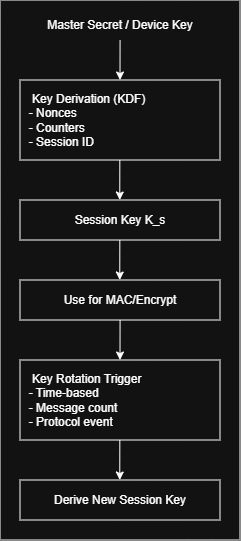
Session keys are derived, used, rotated, and retired in a controlled lifecycle to minimize exposure and ensure communication security.
Figure 2 — Authenticated Key Exchange (AKE)
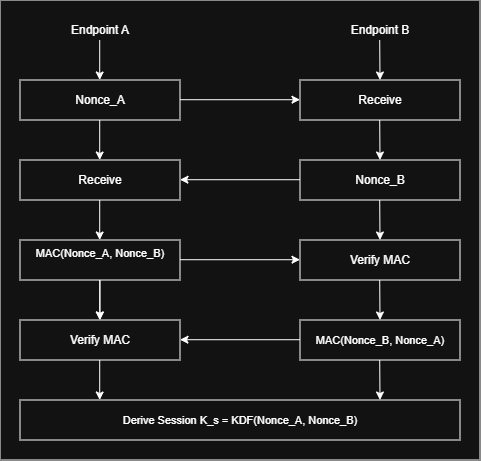
Both endpoints prove possession of long‑term secrets while deriving fresh session keys resistant to replay and MitM attacks.
Figure 3 — Key Desynchronization Detection
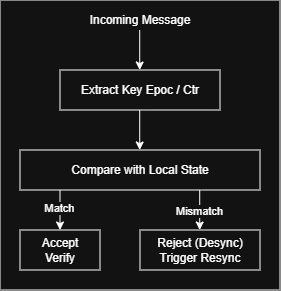
If endpoints disagree on key epoch or counter state, the protocol rejects messages and initiates controlled resynchronization.
Design Principles
1. Keys Must Never Be Static
Static keys → static attack surface.
2. Derive, Don’t Distribute
Endpoints derive keys locally using shared secrets and nonces.
3. Bind Everything to Freshness
Counters and nonces prevent replay of valid MACs.
4. Minimize Key Exposure
Keys should exist only:
- in secure hardware
- for the minimum time
- in the minimum number of components
5. Fail‑Safe Resynchronization
If key epochs diverge, the protocol must:
- reject messages
- initiate resync
- never silently accept mismatched keys
Relationship with Other Security Mechanisms
Secure communication interacts with:
- Replay Protection & Freshness (keys bind to counters/nonces)
- Message Integrity & Authentication Pipeline (MAC/HMAC uses session keys)
- Session Management & Resynchronization (key epochs evolve with session state)
- Security in CRC (CRC is insufficient; MAC requires keys)
- Secure Boot and Key Management (provides the long‑term root of trust)
