
Safety in Protocol Layers — Overview
Introduction
Protocol layers define how data is framed, transmitted, sequenced, acknowledged, and validated across communication systems. In safety‑critical designs, protocols are not just a means of communication — they are diagnostic mechanisms. Sequence counters, CRC fields, timeouts, acknowledgments, and state machines all contribute to detecting faults, preventing data corruption, and ensuring that communication failures do not propagate into hazardous behavior.
Safety analysis at the protocol layer focuses on:
- the integrity of protocol logic
- the robustness of error‑handling mechanisms
- the ability to detect abnormal or inconsistent communication patterns
- the containment of upstream or downstream faults
This page introduces the main safety concerns and mitigation strategies associated with protocol‑layer communication.
Figure 1: Safety in Protocol Layers (Conceptual_Overview)
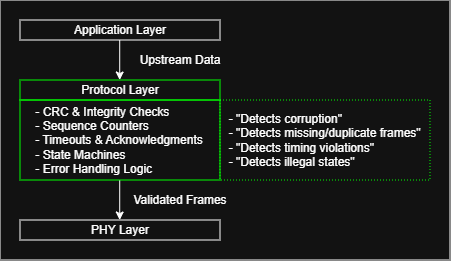
Protocol-layer safety mechanisms prevent communication faults from propagating into hazardous behavior.
Main Safety Risks
Frame corruption
Bit flips or burst errors altering headers, payloads, or CRC fields.
Sequence number errors
Missing, repeated, or out‑of‑order frames due to logic faults or link instability.
Timeout violations
Delayed or missing acknowledgments caused by clock drift, congestion, or hardware faults.
State machine corruption
SEU or logic faults causing invalid protocol states or transitions.
Header corruption
Invalid length fields, type fields, or metadata leading to misinterpretation.
Replay or duplication
Repeated frames due to buffer corruption or retry logic faults.
Dropped frames
FIFO overflow, PHY instability, or internal arbitration faults.
I/O‑related upstream faults
Invalid data entering the protocol layer from sensors or digital I/O.
Clock or timing drift
Affecting inter‑frame spacing, synchronization, or timeout logic.
Figure 2: Sequence Counter Failure Detection

Missing, out‑of‑order, and duplicated frames break the expected sequence progression, allowing the protocol layer to detect replay, loss, or reordering faults.
Mitigation Techniques
CRC and integrity checks
Validating headers, payloads, and metadata.
Sequence counters
Detecting missing, repeated, or out‑of‑order frames.
Timeout supervision
Monitoring acknowledgments, retries, and inter‑frame timing.
State machine hardening
Safe state encoding, redundancy, and illegal‑state detection.
Redundant communication paths
Dual‑channel or dual‑protocol architectures for high‑integrity systems.
Plausibility checks
Validating that data patterns match expected physical or logical behavior.
Error counters
Tracking CRC failures, sequence errors, retries, and timeouts.
End‑to‑end protection
Combining protocol‑layer checks with PHY‑level and application‑level integrity.
Built‑In Self‑Test
Validating protocol logic, counters, and state machines at startup.
ATPG/DFT support
Scan‑based observability of protocol logic and fault coverage measurement.
Figure 3: Timeout Window Supervision
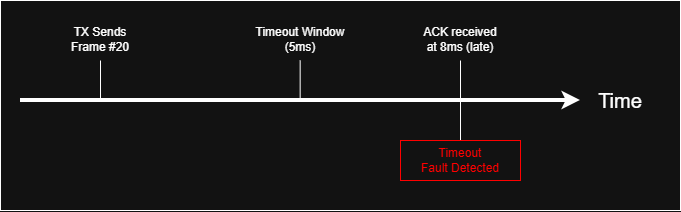
Timeout supervision detects delayed or missing acknowledgments, preventing stalled or inconsistent communication from propagating.
Figure 4: Protocol State Machine Corruption and Recovery
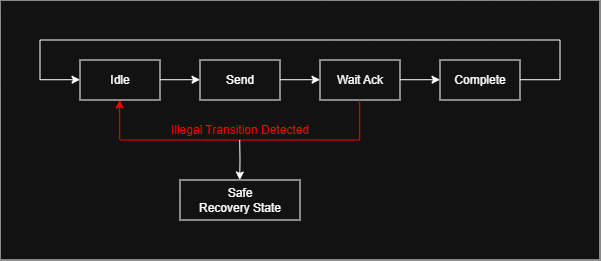
Illegal transitions caused by SEUs or logic faults are detected and redirected to a safe recovery state.
Figure 5: CRC Coverage and Corruption Detection

CRC protects both header and payload, allowing the protocol layer to detect bit flips and burst errors before data is accepted.
Related Technical Pages
Protocol Layer Fundamentals
- Protocol Layering — Architecture Fundamentals
- Protocol Layers & Packet Processing — Overview & Families
Data Integrity & CRC
Protocol Reliability Mechanisms
(Queste sono le nuove pagine che andremo a creare)
- Protocol Layers — Framing and Packet Structure
- Protocol Layers — State Machines and Error Handling
- Protocol Layers — Sequence Counters and Retries
Safety Foundations
Notes for Future Development
- Add diagrams showing:
- sequence counter progression
- timeout windows
- state machine corruption and recovery
- CRC coverage and failure modes
- Add examples from real protocols (CAN, Ethernet, UART, SPI, custom safety protocols)
- Add a comparison table of protocol‑layer safety mechanisms
- Add a section on “Safety Requirements Mapping” (ASIL/IEC 61508)
