
Secure Debug and JTAG Lockdown
Overview
Debug interfaces such as JTAG, SWD, cJTAG, and vendor‑specific debug ports are essential during development, but they represent one of the most dangerous attack surfaces in a deployed SoC.
If left unprotected, an attacker can:
- halt the CPU
- read/write memory
- dump firmware
- bypass secure boot
- extract keys
- disable security features
- inject faults
For this reason, modern SoCs implement Secure Debug: a hardware architecture that controls, restricts, or completely disables debug access based on device lifecycle, authentication, and policy.
Debug Threat Model
Debug interfaces allow:
- full system visibility
- full control over execution
- access to internal buses
- access to memory and registers
- access to crypto engines
- access to HSM interfaces (if not isolated)
Therefore, debug must be treated as a privileged security domain, not as a simple test interface.
Main threats:
- Unauthorized access (physical attacker with probe)
- Firmware extraction
- Key extraction
- Bypassing secure boot
- Fault injection via debug commands
- Privilege escalation
- Lifecycle rollback attacks
Secure Debug Architecture
A secure debug architecture typically includes:
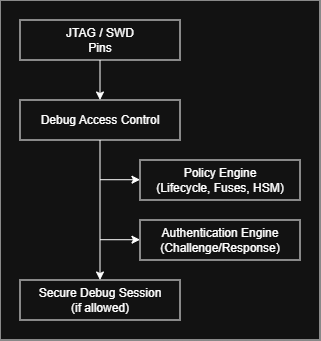
1. Debug Access Controller (DAC)
The hardware block that mediates all debug operations.
2. Policy Engine
Enforces rules based on:
- lifecycle state (development, production, RMA)
- fuse configuration
- provisioning data
- HSM policies
3. Authentication Engine
Implements:
- challenge/response
- certificate‑based authentication
- signed debug tokens
- time‑limited debug sessions
4. Secure Debug Session
If authentication succeeds and policy allows it, a temporary debug session is opened.
Lifecycle‑Based Debug Control
Debug access depends on the device lifecycle:
Development Mode
- full debug access
- no authentication required
- used during bring‑up
Production Mode
- debug disabled by default
- requires authentication
- limited visibility
- no access to secure memory regions
RMA (Return Material Authorization)
- debug allowed only with vendor‑signed token
- device may be wiped before enabling debug
Decommissioned / Locked Mode
- debug permanently disabled
- fuses blown
- no recovery possible
Authentication Mechanisms
Secure debug requires strong authentication:
1. Challenge/Response with HSM
- HSM generates nonce
- external tool signs it with vendor private key
- HSM verifies signature
- session opens
2. Certificate‑Based Debug
- debugger presents certificate chain
- SoC validates chain against root key in HSM
3. Signed Debug Tokens
- time‑limited
- bound to device ID
- bound to lifecycle state
4. PUF‑Derived Secrets
- debug authentication keys derived from PUF
- unique per device
- never stored in NVM
JTAG Lockdown Mechanisms
To prevent unauthorized access, SoCs implement:
1. Pin‑Level Lockdown
- JTAG pins disabled or multiplexed
- requires fuse to enable
2. TAP Controller Lockdown
- TAP state machine blocked
- only IDCODE allowed
- no shift operations
3. Instruction Filtering
- only a subset of JTAG instructions allowed
- memory access instructions blocked
4. Bus Isolation
- debug cannot access secure memory regions
- HSM and crypto engines isolated
5. Fuse‑Based Disable
- permanent disable of debug
- irreversible
Secure Debug Session Flow
Secure debug follows a similar pipeline:

Policy Check
- lifecycle state
- fuse configuration
- HSM policy
Authentication
- challenge/response
- certificate validation
- signed token
Session Key
- ephemeral key generated by HSM
- used to encrypt debug traffic
Secure Session
- limited visibility
- time‑limited
- logged by HSM
Debug Access Restrictions
Even in authenticated sessions, debug access is restricted:
- no access to HSM internal registers
- no access to key registers
- no access to secure memory
- no access to crypto engine internal state
- no access to PUF circuits
- no access to secure boot ROM
Debug must never compromise:
- key confidentiality
- secure boot integrity
- attestation
- lifecycle state
Tamper Detection and Debug
Debug interfaces are often tied to tamper sensors:
- voltage glitch detection
- clock glitch detection
- temperature sensors
- active shield mesh
- light sensors
If tamper is detected:
- debug session is closed
- keys are zeroized
- HSM enters lockdown
Threats and Mitigations
| Threat | Mitigation |
|---|---|
| Unauthorized debug access | Authentication + lifecycle policy |
| Firmware extraction | Memory region isolation |
| Key extraction | HSM isolation + key wrapping |
| Secure boot bypass | Debug gating before ROM |
| Fault injection | Tamper sensors + DAC filtering |
| Replay of debug tokens | Nonces + time‑limited tokens |
| Lifecycle rollback | Fuse‑based monotonic counters |
