
PUF‑based Key Derivation
Overview
A Physical Unclonable Function (PUF) is a hardware primitive that extracts device‑unique secrets from microscopic manufacturing variations. Unlike stored keys, PUF‑derived keys:
- do not exist in non‑volatile memory
- cannot be cloned or copied
- are regenerated on demand
- disappear when power is removed
- are resistant to invasive attacks
PUFs are used to derive:
- Device Root Keys (DRK)
- Key Encryption Keys (KEK)
- HSM internal secrets
- MACsec/IPsec long‑term keys
- Secure Boot keys
- Attestation keys
This page focuses on the hardware architecture of PUF‑based key derivation and its integration with the HSM.
PUF Fundamentals
A PUF exploits physical randomness introduced during silicon manufacturing. Common PUF types include:
1. SRAM PUF
- uses power‑up state of SRAM cells
- high entropy
- widely used in SoCs and secure elements
2. Ring Oscillator PUF
- compares frequencies of nominally identical oscillators
- stable after calibration
3. Arbiter PUF
- measures delay differences in symmetric paths
- requires careful layout
4. Butterfly PUF
- latch‑based
- used in FPGA implementations
5. Composite PUF
- combines multiple PUF types
- improves robustness
PUF Response Characteristics
PUF responses are:
- unique per device
- noisy (not perfectly reproducible)
- not directly usable as keys
- sensitive to temperature, voltage, aging
Therefore, raw PUF bits must be processed through:
- error correction
- helper data
- key derivation functions
PUF Key Reconstruction Pipeline
A typical PUF‑based key derivation pipeline looks like this:
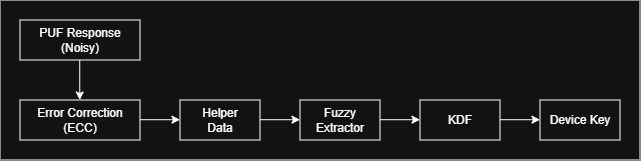
1. Error Correction (ECC)
Corrects bit flips due to noise:
- BCH codes
- Reed‑Solomon
- LDPC
- repetition codes
2. Helper Data
Public, non‑secret metadata that helps reconstruct the key. Must not leak information about the PUF response.
3. Fuzzy Extractor
Transforms noisy PUF output into a stable, uniform secret.
4. Key Derivation Function (KDF)
Derives cryptographic keys from the stable secret:
- HKDF
- SP800‑108
- AES‑CMAC KDF
PUF Enrollment and Reconstruction
PUF‑based systems operate in two phases:
Enrollment (Manufacturing / Provisioning)

During enrollment:
- the PUF is sampled
- helper data is generated
- no key is stored
- helper data is written to NVM or OTP
Reconstruction (Runtime)

At runtime:
- the PUF is sampled again
- helper data corrects noise
- the same key is reconstructed
- the key is injected into secure hardware
Integration with the HSM
The HSM is the orchestrator of PUF‑based key derivation.
HSM responsibilities:
- control PUF sampling
- manage helper data
- run ECC and fuzzy extraction
- run KDF
- wrap derived keys
- inject keys into crypto engines
- enforce key usage policies
PUF‑to‑HSM flow
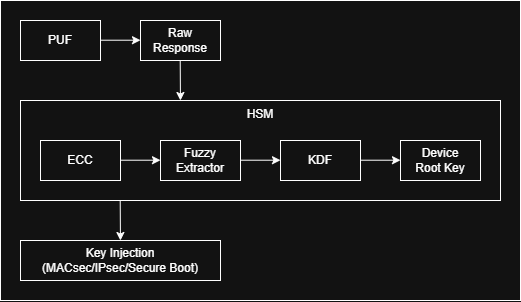
Keys never leave the HSM in plaintext.
PUF‑Derived Keys in the System
PUF‑derived keys are used for:
1. Device Root Key (DRK)
The root of all key hierarchies.
2. Key Encryption Keys (KEK)
Used to wrap:
- MACsec SAK
- IPsec Child SA keys
- Secure Boot keys
- Firmware update keys
3. Attestation Keys
Used to prove device identity.
4. Secure Boot Keys
Used to verify firmware signatures.
5. HSM Internal Secrets
Used for:
- DRBG seeding
- entropy mixing
- internal authentication
Security Properties
PUF‑based keys provide:
Unclonability
No two chips produce the same PUF response.
No Key Storage
Keys are never stored in NVM.
Tamper Resistance
Invasive attacks disturb the physical structure → PUF changes → key cannot be reconstructed.
Side‑Channel Resistance
PUF responses are not repeatedly used like stored keys.
Forward Secrecy
Destroying helper data or PUF state prevents future reconstruction.
Threats and Mitigations
| Threat | Description | Mitigation |
|---|---|---|
| Modeling attacks | Trying to predict PUF behavior | Composite PUFs, fuzzy extractors |
| Helper data leakage | Inferring PUF bits | Secure helper data construction |
| Environmental manipulation | Temperature/voltage attacks | Sensors + compensation |
| Aging | Drift over time | ECC + periodic recalibration |
| Invasive probing | Reading PUF circuits | Tamper mesh + active shields |
PUF vs TRNG
| Feature | PUF | TRNG |
|---|---|---|
| Purpose | Device‑unique keys | Randomness |
| Stability | Deterministic (after ECC) | Non‑deterministic |
| Storage | Not stored | Not stored |
| Attack surface | Physical | Physical + statistical |
| Output | Secret | Entropy |
PUF = identity TRNG = randomness
Entrambi sono necessari.
