
Hardware Security Modules and PUFs
Overview
Hardware Security Modules (HSMs) and Physical Unclonable Functions (PUFs) provide the foundation for secure key storage, cryptographic operations, and device identity. HSMs isolate sensitive operations from the main processor, protecting keys and security logic from software attacks. PUFs exploit intrinsic silicon variations to generate unique, unclonable secrets without storing them explicitly.
Together, they form the hardware root of trust for:
- authentication and attestation
- encryption and MAC/HMAC
- secure boot and measured boot
- lifecycle and provisioning control
Modern architectures increasingly rely on HSMs and PUFs not only for secure boot, but also as always‑on security engines throughout the device lifetime.
Main Security Threats
Key extraction attacks
Probing, side‑channel analysis, or fault injection targeting key storage or cryptographic engines.
HSM bypass
Exploiting firmware vulnerabilities or misconfigurations to access protected operations.
PUF modeling attacks
Using machine learning or repeated queries to approximate PUF behavior.
Invasive physical attacks
Decapping, microprobing, or laser injection to access internal nodes.
Entropy manipulation
Influencing random number generators used for key generation.
Unauthorized key usage
Triggering cryptographic operations without proper authentication or policy checks.
Lifecycle abuse
Exploiting manufacturing or provisioning steps to insert malicious keys.
Replay of PUF challenges
Reusing previously observed challenge‑response pairs.
HSM roles and evolution
Modern HSMs are not all the same. They span a spectrum of complexity and performance:
- Basic secure storage: simple key vault, minimal isolation, limited or no acceleration.
- Isolated crypto engine: keys never leave the HSM; CPU interacts via a controlled interface.
- Parallel crypto HSM: multiple AES/SHA/ECC engines, pipelined and scheduled internally.
- Secure enclave: internal microcontroller, firmware, scheduler, anti‑tamper, full key hierarchy.
Across all variants, the core properties remain:
- keys are never directly accessible to the main CPU
- cryptographic operations are policy‑controlled
- the HSM acts as a trust anchor for the rest of the system
Figure 1 — HSM/PUF Architecture and Isolation Boundary
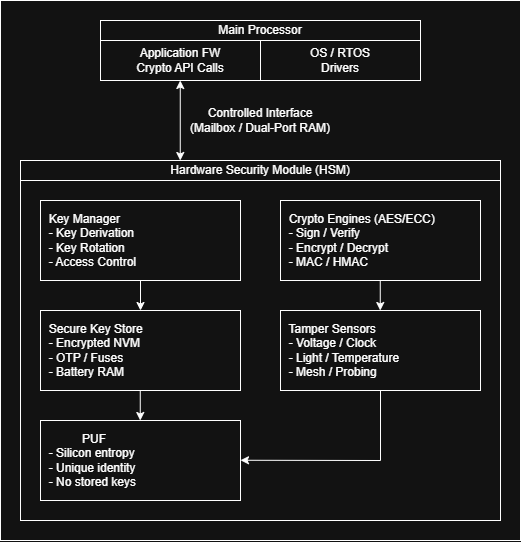
The HSM operates as an isolated hardware enclave. Keys never leave the secure boundary. The CPU interacts only through a controlled mailbox or dual‑port memory interface.
HSM mechanisms
Isolated execution environment
Dedicated hardware that performs cryptographic operations without exposing keys.
Secure key storage
Encrypted memory, fuses, battery‑backed RAM, or PUF‑derived secrets.
Access control and authorization
Only authenticated and authorized components can request cryptographic operations.
Tamper detection
Sensors for voltage, temperature, light, or probing attempts that can trigger key erasure.
Secure boot integration
Verifying firmware signatures using keys stored inside the HSM.
Cryptographic acceleration
Hardware engines for AES, RSA, ECC, SHA, MAC/HMAC.
Lifecycle management
Secure provisioning, key injection, key rotation, and controlled key updates.
HSM interface and performance bottlenecks
The HSM is intentionally isolated. This isolation creates a controlled choke point:
- the CPU communicates via mailbox, dual‑port RAM, or command queues
- data and commands must be copied into and out of the HSM
- each operation incurs overhead: copy → command → process → copy
This interface:
- is essential for security (no direct register access, no raw key reads)
- can become a performance bottleneck if overused for bulk data
- is best suited for high‑value, low‑frequency operations (key derivation, signatures, session setup)
High‑throughput or line‑rate cryptography (e.g., MACsec, IPsec, TLS data path) is typically offloaded to separate crypto engines, while the HSM manages keys and policies.
Figure 2 — Internal Crypto Pipelines and Parallelism

Advanced HSMs use internal pipelines and parallel engines to increase throughput, but the external interface remains a controlled bottleneck.
PUF mechanisms
Silicon‑based uniqueness
Secrets are derived from manufacturing variations that cannot be cloned or predicted.
Challenge‑response pairs
Device‑unique responses to cryptographic challenges, used for identification and authentication.
Key derivation
PUF outputs feed key derivation functions to generate symmetric or asymmetric keys.
Error correction
Helper data and fuzzy extractors stabilize noisy PUF outputs without revealing the secret.
No key storage
Long‑term secrets are not stored; they are reconstructed on demand from the PUF.
Anti‑cloning protection
Each device has a unique, hardware‑bound identity that cannot be duplicated.
Figure 3 — PUF‑Based Key Derivation Flow

The PUF never exposes raw secrets. Keys are derived internally and stored only inside secure hardware.
Relationship with Safety
Safety
Ensures correct system behavior under random faults.
Security
Ensures correct system behavior under malicious manipulation.
Overlap
- Fault injection attacks target both cryptographic logic and safety‑critical logic.
- Tamper sensors can detect both environmental stress and malicious interference.
- HSM integrity ensures that safety mechanisms cannot be disabled by compromised firmware.
