
Safety in FIFO
Overview
FIFO structures are widely used to decouple timing domains, buffer data streams, and absorb latency variations. Because they sit directly in the data path, FIFO failures can propagate quickly and compromise system behavior. Safety analysis focuses on detecting pointer corruption, overflow/underflow conditions, memory faults, and interface‑level anomalies that may lead to hazardous outcomes.
Figure 1: FIFO Safety Failure Modes
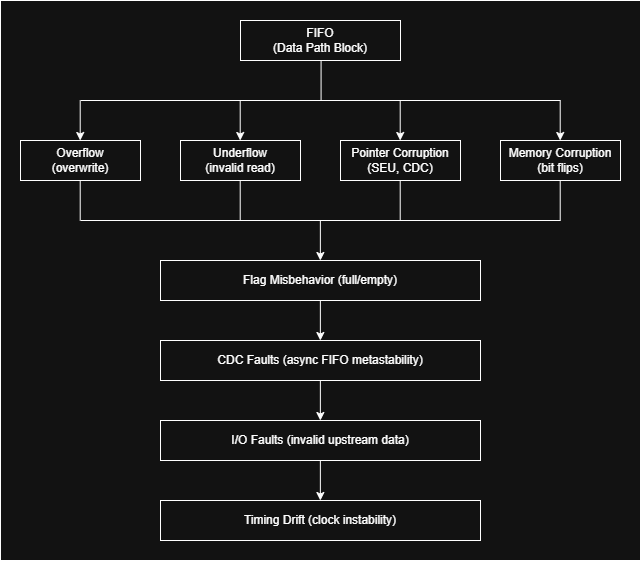
Main FIFO safety failure modes. Overflow, underflow, pointer corruption, memory faults, flag misbehavior, CDC issues, I/O faults, and timing drift represent the primary hazards that can compromise data integrity and system behavior.
Main Safety Risks
Pointer Corruption
Write/read pointers may become misaligned due to SEU, metastability, or logic faults. Effects include invalid addressing, data loss, or misordered data.
Overflow
Incoming data overwrites unread data, causing loss of information. Typical causes include missing backpressure, timing drift, or upstream faults.
Underflow
The system reads invalid or stale data when the FIFO is empty, potentially leading to incorrect control decisions or corrupted data propagation.
Memory Corruption
Bit flips or stuck‑at faults in the FIFO storage array, especially critical in deep FIFOs or high‑reliability data paths.
CDC‑Related Faults
In asynchronous FIFOs, metastability or synchronization failures may corrupt pointers or flags.
Flag Misbehavior
Incorrect full/empty/almost‑full/almost‑empty signaling due to logic faults or CDC issues.
I/O‑Related Faults
Invalid input data caused by upstream digital I/O failures (stuck‑high, stuck‑low, open).
Timing Drift
Clock instability affecting write/read operations, especially in multi‑clock FIFOs.
Mitigation Techniques
Pointer Protection
Parity, ECC, or redundant pointer encoding to detect corruption.
Overflow/Underflow Detection
Explicit checks, safe‑state transitions, and diagnostic counters.
Memory Protection
ECC or parity on FIFO storage cells to detect or correct bit errors.
Redundant Flag Generation
Independent logic to cross‑check full/empty conditions.
Gray‑Coded Pointers
Reduces metastability risk in asynchronous FIFOs.
CDC Hardening
Multi‑stage synchronizers, metastability filtering, and robust CDC design.
Diagnostic Counters
Tracking overflow/underflow events for safety monitoring.
Built‑In Self‑Test (BIST)
Periodic or startup tests on FIFO memory and control logic.
I/O Plausibility Checks
Validating incoming data patterns to detect upstream faults.
Figure 2: Pointer Protection & CDC Hardening
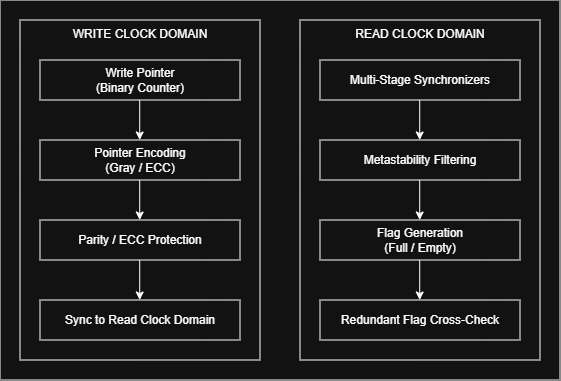
Pointer protection and CDC hardening in asynchronous FIFOs. Pointer encoding (Gray or ECC), parity/ECC checks, multi‑stage synchronizers, metastability filtering, and redundant flag generation ensure robust cross‑domain operation and high diagnostic coverage.
Related Technical Pages
- FIFO — Architecture & Fundamentals
- FIFO — Architecture Basics
- FIFO — CDC Considerations
- FIFO — Data Integrity and Error Handling
(placeholder — link to be added once the page is connected)
