
Security in Data Path & Buffers
Overview
The data path is responsible for moving, transforming, and storing information as it flows through the system. Because it handles raw, unencrypted, timing‑sensitive, and often safety‑critical data, it represents a high‑value target for attackers.
Manipulating the data path can:
- alter computations
- corrupt control decisions
- bypass protocol‑level protections
- inject malicious traffic
- desynchronize pipelines
- leak sensitive information
Security analysis focuses on preventing unauthorized access, detecting tampering, and ensuring that data remains authentic and trustworthy throughout its journey.
Conceptual Diagram — Where Data Path Attacks Occur
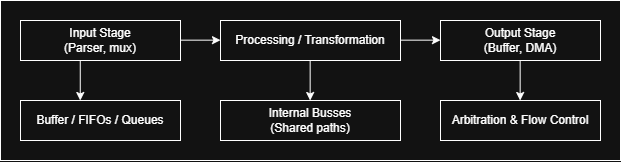
Attacks target every stage: from input multiplexers to internal buses, buffers, and arbitration logic.
Main Security Threats
Data Tampering
Modifying values inside:
- pipelines
- ALUs
- multiplexers
- combinational paths
to alter system behavior or corrupt computations.
Buffer Manipulation
Forcing:
- overflows
- underflows
- stale data reuse
- pointer corruption
to disrupt processing stages or inject malicious data.
Arbitration Abuse
Exploiting priority logic to:
- starve legitimate traffic
- inject unauthorized data
- force timing violations
Multiplexer Spoofing
Manipulating control signals to select:
- unauthorized sources
- stale or uninitialized data
- attacker‑controlled paths
Replay Within Buffers
Reintroducing previously valid data stored in:
- FIFOs
- queues
- ring buffers
to confuse state machines or bypass checks.
Fault Injection Attacks
Inducing:
- timing violations
- glitches
- metastability
to corrupt intermediate values or desynchronize pipelines.
Unauthorized Access to Internal Buses
Probing or injecting signals into:
- shared data paths
- crossbars
- interconnect fabrics
Pipeline Desynchronization
Manipulating valid/ready handshakes to:
- misalign control and data
- cause partial writes
- create inconsistent states
Side‑Channel Leakage
Extracting information from:
- timing
- switching activity
- power consumption
Mitigation Techniques
Integrity Tagging
Attaching:
- validity bits
- sequence counters
- cryptographic tags
to detect tampering or replay.
Redundant Computation
Using:
- dual or lockstep data paths
- comparison logic
to detect corruption or manipulation.
Buffer Supervision
Monitoring:
- fill levels
- access patterns
- overflow/underflow conditions
to detect abnormal behavior.
Arbitration Hardening
Enforcing:
- fairness
- valid grant patterns
- anomaly detection
to prevent starvation or priority abuse.
Multiplexer Validation
Checking that:
- selected sources match expected control logic
- control signals follow legal transitions
Pipeline Monitoring
Detecting:
- illegal states
- unexpected stalls
- abnormal transitions
Access Control on Internal Buses
Restricting which blocks can:
- read
- write
- snoop
shared data paths.
Glitch and Fault Injection Resistance
Using:
- hardened flip‑flops
- synchronizers
- timing monitors
to resist fault injection.
End‑to‑End Cryptographic Integrity
Ensuring that even if internal data is manipulated, tampering is detected at system boundaries.
Built‑In Self‑Test
Validating:
- data path logic
- buffer behavior
- timing integrity
to detect tampering or degradation.
Relationship with Safety
Safety focuses on random corruption:
- timing faults
- metastability
- hardware degradation
- environmental stress
Security focuses on intentional manipulation:
- crafted timing violations
- malicious buffer abuse
- targeted data corruption
Overlap
- Fault injection resembles timing or voltage faults
- Redundant computation detects both accidental and malicious corruption
- Buffer supervision protects against both overflow faults and DoS‑style attacks
