
Safety in Power Management
Overview
Power management governs how the system is powered, monitored, sequenced, and transitioned between operating modes. Voltage regulators, power‑good signals, brown‑out detectors, power switches, and domain controllers ensure that each subsystem receives stable and valid supply conditions.
Because every digital and analog block depends on correct power behavior, faults in the power network can propagate instantly and unpredictably. Safety analysis focuses on detecting undervoltage, overvoltage, brown‑out, sequencing errors, and domain isolation failures.
This page describes the safety‑relevant aspects of power generation, distribution, sequencing, and supervision.
Scope
This page focuses on safety‑relevant failure modes and mitigation strategies in power generation, distribution, sequencing, and domain isolation. Architectural and implementation details are covered in the technical power‑management pages listed below.
Figure 1: Power Safety Architecture

High‑level view of how supply monitoring, sequencing, isolation, and reset supervision interact to guarantee safe operating conditions across all power domains.
Figure 2: Power Sequencing and Domains
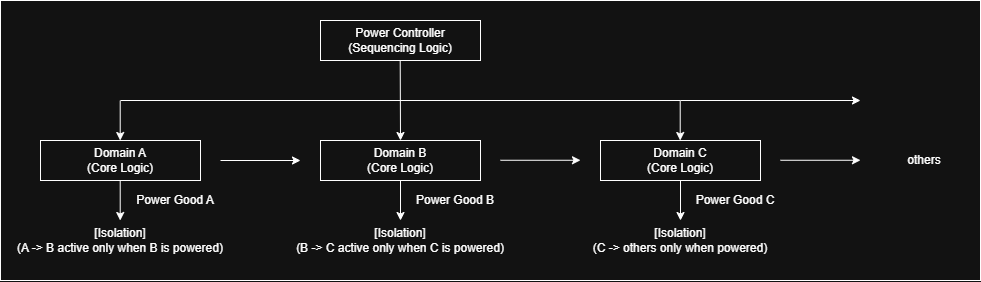
Conceptual representation of power‑up and power‑down sequencing, showing dependencies between domains, power‑good validation, and isolation control.
Main Safety Risks
Brown‑Out Conditions
Supply voltage dips below safe thresholds, causing unpredictable logic behavior.
Overvoltage
Regulator faults or external disturbances can damage circuits or alter logic levels.
Power‑Good Signal Corruption
False positives or negatives due to logic faults, noise, or mis‑sequencing.
Incorrect Power Sequencing
Subsystems powered in the wrong order may initialize incorrectly or enter unsafe states.
Domain Isolation Failures
Leakage or unintended signal propagation between powered and unpowered domains.
Power Switch Faults
Stuck‑on or stuck‑off conditions in power gating logic.
Thermal Runaway
Overheating causing regulator instability or shutdown.
Aging and Drift
Long‑term degradation of regulators, references, or passives.
I/O‑Related Upstream Faults
External rails affected by wiring issues, EMI, or short‑to‑battery/ground.
Reset and Clock Instability
Power faults triggering partial resets or clock drift.
Power faults are among the most dangerous because they can affect all subsystems simultaneously.
Mitigation Techniques
Brown‑Out Detection
Monitor supply voltage and trigger safe‑state transitions when thresholds are violated.
Overvoltage Protection
Clamps, crowbar circuits, and regulator supervision prevent damage and unsafe behavior.
Power‑Good Validation
Cross‑check PGOOD signals with actual voltage measurements to avoid false indications.
Sequencing Controllers
Enforce correct power‑up and power‑down order across domains.
Domain Isolation
Ensure powered‑down domains do not leak or propagate invalid signals.
Redundant Regulators
Dual‑path or monitored supplies for high‑integrity systems.
Thermal Monitoring
Supervise temperature to prevent regulator instability or runaway.
Built‑In Self‑Test (BIST)
Validate power management logic and monitoring circuits at startup.
ATPG/DFT Support
Scan‑based observability of power control logic and fault coverage measurement.
These techniques ensure that power faults are detected early and handled deterministically.
Related Technical Pages
- Power Management — Regulators and References
- Power Management — Sequencing and Power‑Good
- Power Management — Power Gating and Domain Isolation
- Clocking — Gating, Distribution, and CDC
Related Safety Pages
- Safety in Reset
- Safety in Clocking
- Board‑Level Fault Signaling
- Fault Collection and Control Unit (FCCU)
