
Cryptographic Keys — Concepts and Hierarchy
Overview
Cryptographic keys define the identity, trust anchors, and protection boundaries of a secure system. Modern SoCs rely on a layered key hierarchy that separates long‑term secrets, operational keys, and ephemeral session keys. This structure ensures:
- minimal exposure of root secrets
- controlled derivation of subordinate keys
- hardware‑enforced access control
- resistance to cloning and tampering
- scalable key management across features and protocols
This page introduces the fundamental concepts and the typical hierarchy used in secure embedded systems.
Types of Cryptographic Keys
Symmetric Keys
Used for:
- encryption/decryption
- MAC/HMAC
- authenticated encryption (AES‑GCM, ChaCha20‑Poly1305)
- fast data‑path protection
Properties:
- must remain secret
- typically device‑unique
- derived from a root secret or PUF
Asymmetric Keys
Used for:
- signatures
- authentication
- secure boot
- attestation
- certificate chains
Properties:
- public key can be distributed
- private key must be hardware‑protected
- often stored in secure elements or derived from PUF
Hybrid Architectures
Most systems combine both:
- asymmetric keys for identity and authentication
- symmetric keys for bulk data protection
This reduces computational cost while maintaining strong security guarantees.
Key Derivation
Device‑unique symmetric keys can be derived from:
- a master secret
- a PUF response
- a per‑device seed stored in OTP
- a hardware KDF (HKDF, CMAC‑KDF, SP800‑108)
Key derivation ensures:
- uniqueness
- forward secrecy
- no need to store multiple long‑term keys
Key Hierarchy
A secure SoC organizes keys in a layered hierarchy. Here is a typical structure:
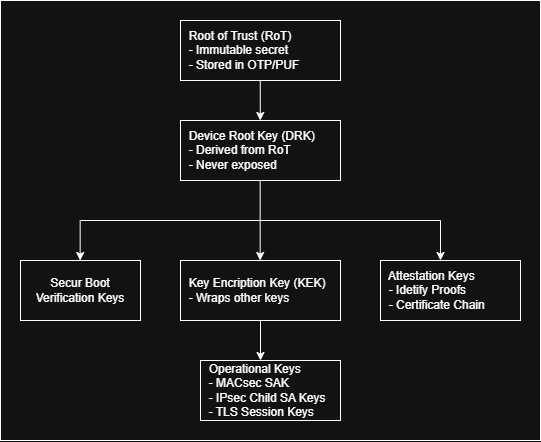
Interpretation
- RoT is the ultimate trust anchor
- DRK is the device‑unique root key
- KEK wraps and protects all other keys
- Operational keys are short‑lived and protocol‑specific
This hierarchy minimizes exposure and enforces strict separation of trust domains.
Key Usage Domains
Different keys serve different purposes:
Identity Keys
- attestation
- device authentication
- certificate signing
Boot and Firmware Keys
- secure boot
- firmware integrity
- anti‑rollback
Transport and Protocol Keys
- MACsec SAK
- IPsec SA keys
- TLS session keys
Application Keys
- encrypted storage
- secure communication
- DRM or content protection
Each domain has its own lifetime, access rules, and derivation path.
Key Protection Mechanisms
Hardware Storage
- OTP / eFuses
- secure registers
- battery‑backed RAM
- HSM internal memory
Encrypted Key Storage
Keys stored in flash/NVM are encrypted with:
- KEK
- DRK
- PUF‑derived secrets
Access Control
Only authorized hardware or firmware can:
- read
- derive
- wrap
- use
keys.
PUF‑Derived Keys
Provide:
- no long‑term storage
- per‑device uniqueness
- resistance to invasive attacks
Threats to Key Hierarchies
| Threat | Description |
|---|---|
| Key extraction | Reading keys from memory or buses |
| Cloning | Copying keys to duplicate devices |
| Weak entropy | Predictable key generation |
| Side‑channel attacks | Leakage via power/timing |
| Fault injection | Bypassing key usage checks |
| Improper key wrapping | Exposing subordinate keys |
Mitigation Techniques
- hardware‑anchored root keys
- PUF‑based derivation
- encrypted key storage
- strict access control
- key diversification
- tamper detection and zeroization
- strong TRNGs
- lifecycle‑based restrictions
