
Retiming — Principles and Techniques
Overview
Retiming is a transformation technique that relocates registers within a synchronous circuit to improve timing, balance pipeline stages, or reduce critical path delays — without changing the functional behavior of the design.
It is one of the most powerful optimizations available to digital designers and synthesis tools. By shifting registers across combinational logic, retiming can:
- reduce the critical path
- increase maximum clock frequency
- balance pipeline stages
- reduce area or power in some cases
- improve timing closure robustness
Retiming preserves the input/output behavior of the circuit but may change the internal register distribution.
Conceptual Diagram — What Retiming Does
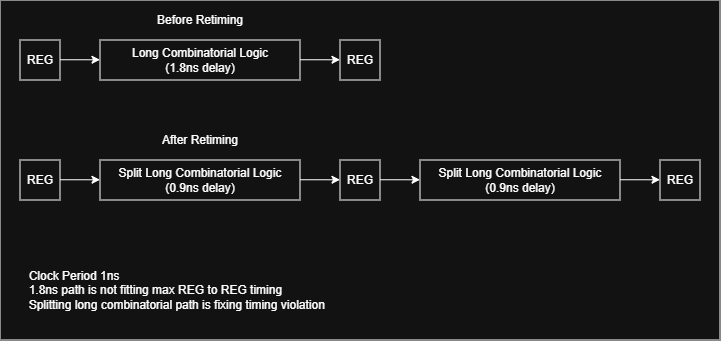
Retiming of a critical path: the long combinational path is split into multiple shorter segments by moving or adding registers, creating an internal pipeline that reduces per‑stage delay and allows the design to meet timing constraints.
Why Retiming Matters
- Critical path reduction Moving registers can break long combinational paths.
- Pipeline balancing Ensures each stage has similar delay, improving throughput.
- Timing closure Helps meet frequency targets without redesigning logic.
- Tool‑driven optimization Modern synthesis tools perform automatic retiming when allowed.
- Functional equivalence External behavior remains unchanged.
Principles of Retiming
1. Register Movement Across Logic
Registers can be moved:
- forward (toward outputs)
- backward (toward inputs)
as long as the number of registers on every cycle in the graph remains valid.
2. Preservation of Sequential Behavior
Retiming must preserve:
- number of registers on feedback loops
- overall pipeline latency (unless explicitly changed)
- functional equivalence at I/O boundaries
3. Graph‑Based Formulation
Retiming is often modeled as:
- a directed graph
- nodes = combinational logic
- edges = registers
- weights = number of registers
Algorithms compute optimal register placement.
4. Legal Moves
A retiming move is legal if:
- it does not create negative register counts
- it does not violate reset/enable semantics
- it preserves feedback loop register counts
Manual Retiming Techniques
Critical Path Splitting
Identify long combinational paths and insert/move registers to break them.
Pipeline Balancing
Ensure each stage has similar delay to maximize throughput.
Register Cloning
Duplicate registers to reduce fan‑out or isolate timing domains.
Boundary Retiming
Move registers closer to module boundaries to simplify timing closure.
Automatic Retiming (Tool‑Driven)
Synthesis tools can perform retiming automatically when:
- registers have no asynchronous reset
- registers have uniform enable conditions
- logic is purely synchronous
- retiming is enabled in constraints
Tools may:
- push registers forward/backward
- merge or split pipeline stages
- optimize feedback loops
Constraints and Limitations
Retiming is limited by:
- asynchronous resets (cannot be moved freely)
- clock enables (must preserve gating semantics)
- multi‑cycle paths
- false paths
- black‑box boundaries
- I/O timing constraints
Designers often need to restructure logic to make retiming possible.
Failure Modes and Risks
- Incorrect reset behavior if registers with async reset are moved improperly
- Pipeline misalignment if control signals are not retimed consistently
- Debug difficulty due to changed internal register placement
- Tool limitations when dealing with gated clocks or complex enables
Relationship with Timing Closure
Retiming is one of the most effective techniques for timing closure:
- reduces worst‑case delay
- improves slack margins
- reduces sensitivity to PVT variations
- enables higher clock frequencies
Often used together with:
- logic restructuring
- register duplication
- floorplanning
- clock gating optimization
Related Technical Pages
- Timing & Synchronization — Overview
- Timing and Synchronization — Principles and Constraints
- Clock Domain Crossing — Architecture & Fundamentals
- Clock Domain Crossing — Practical Guidelines
- Clock Generation & Phase Alignment — Architecture & Fundamentals
- Clock Trees — Architecture & Practical Considerations
- Jitter & Phase Noise — Fundamentals
